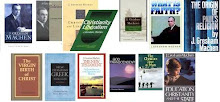
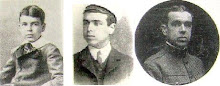
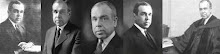

This blog chiefly seeks to collate materials available elsewhere on the net by or about J Gresham Machen


Saturday, 15 January 2011

By a former student


J. Gresham Machen, Man of God
John P. Galbraith

Most people who know the name J. Gresham Machen think almost exclusively: theologian. That is understandable. He was one of God's great theologians, and he was known widely through his theological writings. Yet, deep as his theology was, it was only the foundation of what the man Machen really was.
It was my inestimable privilege to be a student of his for two and a half years at Westminster Theological Seminary in Philadelphia, from September 1934 until his death on January 1, 1937. It may be that I, at age 97, am the only one living who knew him as a teacher and in his ministerial calling. It is such a privilege to still have the memories!
It was not Machen the theologian who drew me to Westminster. It was Machen the loving and devoted follower of Jesus his Savior, the one who raised the flag of truth at all costs, who gripped me. His watchword, as it were, was: God's Word is my command. Before I ever entered seminary, what would become a lifelong memory was founded. For Machen, it was not just a Presbyterian conflict in which he had become engaged, but a proclamation of the gospel for the entire world. His positions were, thus, not of his own devising, but the careful exegesis of the Scriptures.
Machen, however, was more than a theologian, more than a devotee of God's Word. He was a quiet, kind, modest, and sociable person. He was of medium height, a little bit overweight, and he always had a sparkle in his eyes. He was attentive to his students and did many fine things for them. Occasionally he would have what he called a "Checker Club" on a Saturday evening in his apartment building, Chancellor Hall, a high-rise a few blocks from the Seminary. He set out games (especially checkers and chess) and bowls of fruit and snacks, and he mixed well with the students. He would say, "Don't be a tightwad!"— hoping that we would be generous to ourselves.
At other times, when he was home over a weekend (he had many preaching engagements), he would send word to our "dormitory," the Gladstone Hotel, that anyone available was welcome to have dinner with him at the fashionable Drake Hotel on Sunday after morning worship. During the football season — he was an avid college-football fan —h e would buy groups of tickets to games at the University of Pennsylvania and distribute them among the students at Westminster.
As a professor, he was careful, clear, and precise in his teaching. When I caught on to how he approached New Testament exegesis, I took every one of his elective exegesis courses that I could. One of his major purposes was to teach us to arrive at the meaning of the text without making unwarranted assumptions. That emphasis fitted well with a famous emphasis of his Old Testament colleague and our professor, Oswald T. Allis: "Gentlemen, respect the silences of Scripture!" Never were we allowed to forget that the text is the Word of God and that the Word of God is what we preach.
Machen also had a built-in means of entertaining students. He was certainly not a curmudgeon, as his enemies declared. If anything, he was a humorist! One could say, even, that he was a stand-up comedian. He had a number of delightful stories that did not use words, but sounds made with his mouth — all told with those sparkling eyes. Being a student of Machen was not all work.
Dr. Machen, to the surprise of many, was an enthusiastic mountain climber, particularly in the Swiss Alps, though also in the Canadian Rockies and in the U.S. He loved the beauty and majesty of the natural world, and was thrilled to stand at the summits of great peaks and glory in what God had made. One of his favorite climbing adventures was Cadillac Mountain on Mount Desert Island, off the coast of Maine. He was horrified, and personally protested, that the mountain would be ruined by the building of a road in the interests of tourists. This was somewhat like his protest against the City of Philadelphia passing a law to forbid pedestrians from crossing intersections in the downtown over against a traffic signal.
He did indeed have his prejudices — such as his disdain for a new translation of the Bible that he believed was not as good as it should be. As a guest preacher at Immanuel Church in Morristown, New Jersey (now Immanuel OPC in Whippany), he began to use the pulpit Bible, saw what translation it was, and set it aside. He then used his own King James Bible.
On a more serious note, he did not try to impose his views on others. When the doctrinal conflict arose in the Presbyterian Church in the USA, he followed the set procedures for addressing his problems to the proper authorities. As the conflict turned toward a decision, some fellow students and I travelled to Trenton to view the conclusion of Machen's trial before the Presbytery of New Brunswick (New Jersey). When he was told to rise, he rose without a word. He was silent as charges were read to him, and then was seated. I could not refrain from thinking of Isaiah 53, which says of Christ, "as a lamb before his shearers is dumb, so he opened not his mouth." Later, when he had been declared guilty of disturbing the peace and unity of the Church, and the Church had been told that it was the duty of all members to support whatever the Church allowed, he saw that his only way to avoid participating in the false teachings of the PCUSA was to leave it. His course, if his church was going to require him to support unbelief, was to join with others in a new church that would seek to follow the Word of God as the final standard of truth in all things.
Machen stood alone at Trenton, but the next month (June 1936) I had the privilege, with my father, mother, and sister, to stand with him and one hundred and twenty-six others called together through the Presbyterian Constitutional Covenant Union at the New Century Club in Philadelphia. We stood when those desiring to affiliate with a new church were called to rise and be counted as founding members of the Presbyterian Church of America (renamed the Orthodox Presbyterian Church in 1939). Then, from that group, thirty-four ministers and seventeen elders (including my father) constituted the Church's First General Assembly. Dr. Machen was elected without opposition as the moderator. Machen himself would say, "We became members at last of a true Presbyterian Church." What a memory to have of the man whom God chose to lead us, J. Gresham Machen, man of God.
The author, a retired minister, has served the OPC in many capacities. New Horizons, January, 2011.

Recent Conference 2011


A conference on Machen recently took place at Westminster Seminary in California. The schedule was

“Christianity and Liberalism Today” –Michael S. Horton
“The Perennial Machen” –D.G. Hart
“Machen and the Bible” –Joel. E. Kim
“Machen and the Gospel” –J.V. Fesko
“Machen and Ethics” –David VanDrunen
“Machen, Christianity, and the Church” –W. Robert Godfrey
“Q & A” -Faculty
More here

Monday, 1 November 2010

On the Fear of God

Machen's piece on the fear of God can be found here. it was published in God Transcendent.

On predestination

I found this here

J. Gresham Machen (d. 1937) has an oustanding explanation of predestination in his little book The Christian View of Man. I realize this biblical doctrine is a tough one. If you’ve wrestled with it or know someone who struggles with this doctrine, I recommend reading chapters 3-6 of The Christian View of Man. I’ll give a few excerpts below. First, he says the main question at hand is

“…whether a man is predestinated by God to salvation because he believes in Christ or is enabled to believe in Christ because he is predestinated.”

After discussing a few different views of predestination, he notes this:

“[The Bible] is utterly opposed to the view that God does not know what man will decide, and it is equally opposed to the view that what God foreknows he does not foreordain. Over against such views, it tells us in the clearest possible way, not only in general that God has foreordained all things according to the counsel of his will but also in particular that he has foreordained the salvation of some men and the loss of others.”

“We do not, indeed know what the reason for God’s choice is. … But because we do not know what the reason is for God’s choice of some and his passing by of others, that does not mean there is no reason. As a matter of fact, there is without doubt an altogether good and sufficient reason. We can be perfectly sure of that. God never acts in arbitrary fashion; he acts always in accordance with infinite wisdom; all his acts are directed to infinitely high and worthy ends. We must just trust him for that. We do not know why God has acted thus and not otherwise, but we know the One who knows and we rest in his infinite justice and goodness and wisdom.”

“Little hope have we, my friends, if our salvation depends upon ourselves; but the salvation of which the Bible speaks is rooted in the eternal counsel of God. [Here Machen quotes Rom 8.28 & 30] There, my friends, is the true ground of all our comforts – not in our love, not in our faith, not in anything that is in us, but in that mysterious and eternal counsel of God from which comes all faith, all love, all that we have and are and can be in this world and in the world to come.”

Again, this is an outstanding treatment of predestination. Machen (as always) writes clearly, biblically, and pastorally. He deals with objections well, and ends this section with a brief discussion of the beauty of God’s gracious act of choosing and saving wicked rebels. If you haven’t read this book, The Christian View of Man, I’d say get it! It is written for the average layperson, so most thoughtful Christians will be able to benefit from it. While I’m at it, I also recommend What is Faith by Machen, which is one of the best presentations of faith alone and justification that I’ve read – its right up there with some of Luther’s sermons. [I also need to note that each of these books is less than $10 - probably under $5 if you get them used!]

Wednesday, 16 June 2010

Serious humour and tobacco


I have come to the conclusion that the two institutions which Germany most needs are (1) The Sabbath; and (2) American Football.
... What a wonderful aid tobacco is to friendship and Christian fellowship.
“The fellows are in my room now on the last Sunday night, smoking the cigars and eating the oranges which it has been the greatest delight I ever had to provide whenever possible. My idea of delight is a Princeton room full of fellows smoking. When I think what an aid tobacco is to friendship and Christian patience, I have sometimes regretted that I never began to smoke.” Stonehouse Biography pp 84, 85, 506

Machen on social betterment

material benefits were never valued in the apostolic age for their own sake, they were never regarded as substitutes for spiritual things. That lesson needs to be learned. Social betterment, though important, is insufficient; it must always be supplemented by God’s unspeakable gift,
J Gresham Machen, New Testament, ed, John Cook, pp 345, 346

Thursday, 18 February 2010

Facebook

There is a facebook page for Facebook users who are Machen fans here

Reformed Audio

You will find some useful Machen materials at Reformed Audio

Monday, 26 October 2009

Machen on Controversy

Again, men say that instead of engaging in controversy in the Church, we ought to pray to God for a revival; instead of polemics, we ought to have evangelism. Well, what kind of revival do you think that will be? What sort of evangelism is it that is indifferent to the question what evangel is it that is to be preached? Not a revival in the New Testament sense, not the evangelism that Paul meant when he said, 'Woe is be unto me, if I preach not the gospel.' No, my friends, there can be no true evangelism which makes common cause with the enemies of the Cross of Christ. Souls will hardly be saved unless the evangelists can say with Paul: "If we or an angel from heaven preach any other gospel than that which we preached unto you, let him be accursed!"Every true revival is born in controversy, and leads to more controversy. That has been true ever since our Lord said that He came not to bring peace upon the earth but a sword. And do you know what I think will happen when God sends a new Reformation upon the Church? We cannot tell when that blessed day will come. But when the blessed day does come, I think we can say at least one result that it will bring. We shall hear nothing on that day about the evils of controversy in the Church. All that will be swept away as with a mighty flood. A man who is on fire with a message never talks in that wretched, feeble way, but proclaims the truth joyously and fearlessly, in the presence of every high thing that is lifted up against the gospel of Christ.
J Gresham Machen, The Importance of Christian Scholarship

Machen on Good News

What I need first of all is not exhortation, but a gospel, not directions for saving myself but knowledge of how God has saved me. Have you any good news? That is the question that I ask of you. I know your exhortations will not help me. But if anything has been done to save me, will you not tell me the facts?
J Gresham Machen, Christian Faith in the Modern World