This blog chiefly seeks to collate materials available elsewhere on the net by or about J Gresham Machen


Showing posts with label Westminster Theological Seminary. Show all posts

Tuesday, 20 June 2023

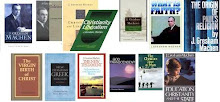
Christianity and Liberalism Legacy Edition


In 2019 Westminster Theological Seminary produced a now hard to obtain (except in e-form) legacy edition of Machen's Christianity and Liberalism with a number of interesting extras. Machen founded the seminary in 1929. There is a Foreword by Peter A. Lillback and an Introduction by David B. Garner. There are also a number of essays by the Faculty of Westminster Theological Seminary, as follows:

“Machen and History” by Chad Van Dixhoorn
“J. Gresham Machen, Fundamentalism, and Westminster Seminary” by Peter A. Lillback
“Machen and Apologetics” by William Edgar
“Machen and Philosophy” by K. Scott Oliphint
“Christianity and Liberalism and Preaching” by John Currie
“Christianity and Liberalism and the Church” by Alfred Poirier
“The Value of Christianity and Liberalism to World Missions” by R. Kent Hughes
“Machen and Scholarship” by Sandy Finlayson
“Machen and Liberalism” by R. Carlton Wynne
“Machen on the True Christian Religion” by Lane G. Tipton
“Salvation’s Center: The Sufferings of Christ and the Glories that Follow” by Iain Duguid
“The Historicity of Adam: A Gospel Presupposition” by Jonathan Gibson
“Christianity and Liberalism and the Old Testament as History” by Elizabeth W. D. Groves
“Christianity and Liberalism and Biblical Prophecy” by Stephen M. Coleman
“Machen and Christ’s View of the Old Testament” by G.K. Beale
“Christianity and Liberalism and the Gospels” by Brandon D. Crowe
“Christianity and Liberalism and Hermeneutical Presuppositions” by Vern S. Poythress

I have now managed to get hold of a paperback copy of the work and have enjoyed reading the brief essays.

Wednesday, 3 July 2013

Machen and the faculty


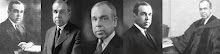
Portrait of the founding faculty of WTS - (L to R) Ned Stonehouse, O.T. Allis, John Murray (standing), J. Gresham Machen, Allan McRae (standing), Paul Woolley, Cornelius Van Til. From here. Machen, Allis and Van Til had served in Princeton (as did Murray as an instructor for one year). Also Robert Dick Wilson, missing from this picture, as is R B Kuiper.

Thursday, 27 September 2012

Machen's Wars - Consolations in the midst of battle

3. Machen's wars – Consolations in the midst of battle
The final thing I would like to do is to consider a short address that Machen gave to the second batch of outgoing students from Westminster Seminary in 1931. It is of interest to us here because it is headed in published form (see Hart's Selected shorter writings) Consolations in the midst of battle. It is interesting because the battle that Machen has in mind is not World War I and, although he clearly has in mind the battle for the truth that he and others were then involved in that was still raging at the time, what has to say has relevance to every age. It is the same theme as that which he touched on in his last address to the Princeton students. Then he said
God grant that you … may be fighters, too! Probably you have your battles even now; you have to contend against sins gross or sins refined; you have to contend against the sin of slothfulness and inertia; ... against doubt and despair. Do not think it strange if you fall thus into divers temptations. The Christian life is a warfare after all. John Bunyan rightly set it forth under the allegory of a Holy War; and when he set it forth, in his greater book, under the figure of a pilgrimage, the pilgrimage, too, was full of battles.
Early on in the Westminster address he mentions the twin evils of opposition from the world and from a worldly church, enemies we still face today. “The world today” he says “is opposed to the faith that you profess and the visible church, too often, has made common cause with the world.”
He reminds them that this has always been the case and that the Saviour warned us that it would be so. In light of this, Westminster, he says, was looking for men willing to bear the reproach of Christ and to work hard at studying God's Word.
The consolations or comforts he offers are twofold. First, and not to be underestimated, there is “the affections and prayers of the little company of men, unpopular with the world, who you have called your teachers”. He reminds them that these comrades stand with far more than seven thousand who have not bowed the knee to Baal.
He reminds them, secondly and more expansively, that his was not the first period when the Christian church was tempted to be discouraged by events. “Again and again” he says “the gospel has seemed to be forever forgotten; yet always it has burst forth with new power and the world has been set aflame.” He wants them to be expectant then and meanwhile not to be unduly impressed “by the pomp and power of this unbelieving age”.
He then describes how a week earlier he had looked down on the city from the 102nd floor of the then newly completed Empire State Building in New York. He states how impressed he was by it all but he says that his mind then went to other buildings he had seen before. He thought particularly of the great cathedrals of England and the continent, living expressions of the human soul and act of worship to Almighty God.
He suggests that while modern builders may be good at lifting the body (1240 feet in record time) they do not compare with the ability of builders in former times to lift the soul. In a flight of fantasy he continues his contrast between the virtual Tower of Babel that he had more recently visited and the ancient cathedrals built over centuries designed to lift ones faith on wings to “the very presence of the infinite God”.
He is eager for his enthusiasm not to be construed as anti-modern or as a call for obscurantism and narrowness. Quite the opposite. No Machen dares to dream of a future time when God will send to the world “something far greater than genius – a humble heart finding in his worship the highest use of al knowledge and all power”. He longs for the rejection of materialism and the embrace of a true view of man.
Meanwhile it is “a drab and empty age” they are in when God's law is forgotten and men are in slavery. Hungry souls are thirsting and hungry for bread, a hunger these men could still by preaching the Word. His desire is not for a novel sect but for a company of men steeped in the Word and in the best scholarly traditions, who labour, mediate and pray in order to faithfully preach.
He wonders aloud
Perhaps you may be the humble instruments, by the use of whatever talents God has given you, of lifting preaching out of the rut into which too often it has fallen, and of making it again, by God's grace, a thing of power.
He closes by saying
Remember this, at least – the things in which the world is now interested are the things that are seen; but the things that are seen are temporal, and the things that are not seen are eternal. You, as ministers of Christ, are called to deal with the unseen things. You are stewards of the mysteries of God. You alone can lead men, by the proclamation of God’s word, out of the crash and jazz and noise and rattle and smoke of this weary age into the green pastures and beside the still waters; you alone, as ministers of reconciliation, can give what the world with all its boasting and pride can never give – the infinite sweetness of the communion of the redeemed soul with the living God.

Saturday, 15 January 2011

By a former student


J. Gresham Machen, Man of God
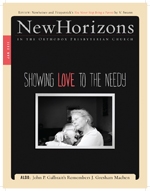
John P. Galbraith

Most people who know the name J. Gresham Machen think almost exclusively: theologian. That is understandable. He was one of God's great theologians, and he was known widely through his theological writings. Yet, deep as his theology was, it was only the foundation of what the man Machen really was.
It was my inestimable privilege to be a student of his for two and a half years at Westminster Theological Seminary in Philadelphia, from September 1934 until his death on January 1, 1937. It may be that I, at age 97, am the only one living who knew him as a teacher and in his ministerial calling. It is such a privilege to still have the memories!
It was not Machen the theologian who drew me to Westminster. It was Machen the loving and devoted follower of Jesus his Savior, the one who raised the flag of truth at all costs, who gripped me. His watchword, as it were, was: God's Word is my command. Before I ever entered seminary, what would become a lifelong memory was founded. For Machen, it was not just a Presbyterian conflict in which he had become engaged, but a proclamation of the gospel for the entire world. His positions were, thus, not of his own devising, but the careful exegesis of the Scriptures.
Machen, however, was more than a theologian, more than a devotee of God's Word. He was a quiet, kind, modest, and sociable person. He was of medium height, a little bit overweight, and he always had a sparkle in his eyes. He was attentive to his students and did many fine things for them. Occasionally he would have what he called a "Checker Club" on a Saturday evening in his apartment building, Chancellor Hall, a high-rise a few blocks from the Seminary. He set out games (especially checkers and chess) and bowls of fruit and snacks, and he mixed well with the students. He would say, "Don't be a tightwad!"— hoping that we would be generous to ourselves.
At other times, when he was home over a weekend (he had many preaching engagements), he would send word to our "dormitory," the Gladstone Hotel, that anyone available was welcome to have dinner with him at the fashionable Drake Hotel on Sunday after morning worship. During the football season — he was an avid college-football fan —h e would buy groups of tickets to games at the University of Pennsylvania and distribute them among the students at Westminster.
As a professor, he was careful, clear, and precise in his teaching. When I caught on to how he approached New Testament exegesis, I took every one of his elective exegesis courses that I could. One of his major purposes was to teach us to arrive at the meaning of the text without making unwarranted assumptions. That emphasis fitted well with a famous emphasis of his Old Testament colleague and our professor, Oswald T. Allis: "Gentlemen, respect the silences of Scripture!" Never were we allowed to forget that the text is the Word of God and that the Word of God is what we preach.
Machen also had a built-in means of entertaining students. He was certainly not a curmudgeon, as his enemies declared. If anything, he was a humorist! One could say, even, that he was a stand-up comedian. He had a number of delightful stories that did not use words, but sounds made with his mouth — all told with those sparkling eyes. Being a student of Machen was not all work.
Dr. Machen, to the surprise of many, was an enthusiastic mountain climber, particularly in the Swiss Alps, though also in the Canadian Rockies and in the U.S. He loved the beauty and majesty of the natural world, and was thrilled to stand at the summits of great peaks and glory in what God had made. One of his favorite climbing adventures was Cadillac Mountain on Mount Desert Island, off the coast of Maine. He was horrified, and personally protested, that the mountain would be ruined by the building of a road in the interests of tourists. This was somewhat like his protest against the City of Philadelphia passing a law to forbid pedestrians from crossing intersections in the downtown over against a traffic signal.
He did indeed have his prejudices — such as his disdain for a new translation of the Bible that he believed was not as good as it should be. As a guest preacher at Immanuel Church in Morristown, New Jersey (now Immanuel OPC in Whippany), he began to use the pulpit Bible, saw what translation it was, and set it aside. He then used his own King James Bible.
On a more serious note, he did not try to impose his views on others. When the doctrinal conflict arose in the Presbyterian Church in the USA, he followed the set procedures for addressing his problems to the proper authorities. As the conflict turned toward a decision, some fellow students and I travelled to Trenton to view the conclusion of Machen's trial before the Presbytery of New Brunswick (New Jersey). When he was told to rise, he rose without a word. He was silent as charges were read to him, and then was seated. I could not refrain from thinking of Isaiah 53, which says of Christ, "as a lamb before his shearers is dumb, so he opened not his mouth." Later, when he had been declared guilty of disturbing the peace and unity of the Church, and the Church had been told that it was the duty of all members to support whatever the Church allowed, he saw that his only way to avoid participating in the false teachings of the PCUSA was to leave it. His course, if his church was going to require him to support unbelief, was to join with others in a new church that would seek to follow the Word of God as the final standard of truth in all things.
Machen stood alone at Trenton, but the next month (June 1936) I had the privilege, with my father, mother, and sister, to stand with him and one hundred and twenty-six others called together through the Presbyterian Constitutional Covenant Union at the New Century Club in Philadelphia. We stood when those desiring to affiliate with a new church were called to rise and be counted as founding members of the Presbyterian Church of America (renamed the Orthodox Presbyterian Church in 1939). Then, from that group, thirty-four ministers and seventeen elders (including my father) constituted the Church's First General Assembly. Dr. Machen was elected without opposition as the moderator. Machen himself would say, "We became members at last of a true Presbyterian Church." What a memory to have of the man whom God chose to lead us, J. Gresham Machen, man of God.
The author, a retired minister, has served the OPC in many capacities. New Horizons, January, 2011.

Recent Conference 2011


A conference on Machen recently took place at Westminster Seminary in California. The schedule was

“Christianity and Liberalism Today” –Michael S. Horton
“The Perennial Machen” –D.G. Hart
“Machen and the Bible” –Joel. E. Kim
“Machen and the Gospel” –J.V. Fesko
“Machen and Ethics” –David VanDrunen
“Machen, Christianity, and the Church” –W. Robert Godfrey
“Q & A” -Faculty
More here

Wednesday, 17 September 2008

Machen and WTS Faculty

Machen is at the centre with Ned B. Stonehouse, O.T. Allis, Paul Woolley and Cornelius Van Til either side of him and John Murray and Allan MacRae at the back.

Monday, 8 September 2008

WTS Brochure 1931

See here for an early brochure for Westminster Theological Seminary